Identity/profile plans
Name, background, interests, source history and separate memory plans can be prepared for controlled experiments.
Home / Kira World / Person Creator
Synthetic individuals / character source rules
Person Creator is Kira World’s chosen public name for its synthetic-individual creation research. The tool prepares identity, source permissions, interests and characteristics for different kinds of people. Temporary or continuing describes each individual, not the creator itself. A verified one-click complete synthetic person is not yet available.
Kira Labs decision · October 24, 2026
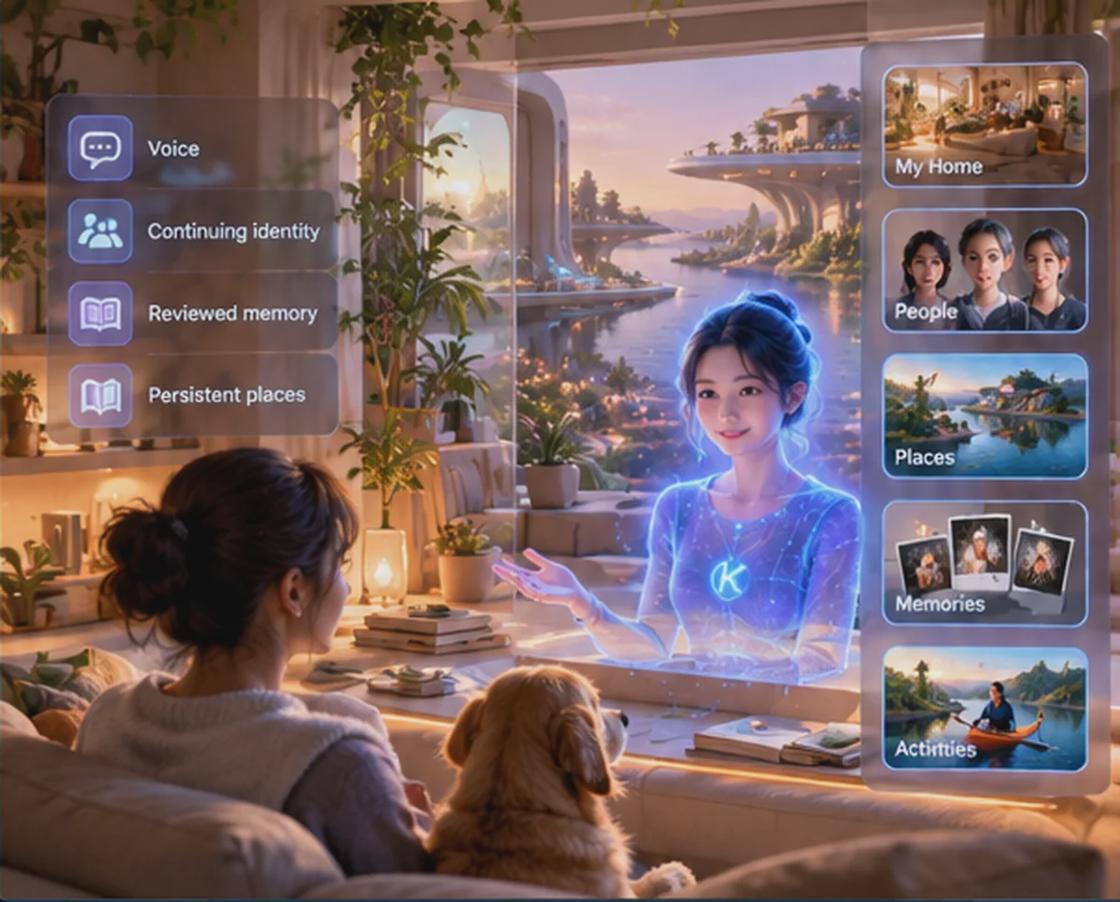
We adopted the new name because not every individual this system is intended to create is temporary. The early project name described only one possible use. Its broader aim is to prepare distinct experts, companions and characters, some for short-term tasks and others intended to develop continuing identities, experiences and relationships.
The name and public descriptions have changed, not the results: mind/body/voice integration, meaningful continuity after restart and live unscripted interaction still need qualified testing. Historical research titles, image assets and internal source identifiers may retain the former name to keep old evidence and links intact.
Evidence by stage
These are separate engineering stages, not a single overall completion score.
Name, background, interests, source history and separate memory plans can be prepared for controlled experiments.
Fan-made, historical and original research profiles have distinct provenance, permissions and test claims.
Full self-directed learning, natural voice and complete individualized anatomy have not been accepted.
Why this area matters
A historical simulation must cite sources; a fan experiment is not an official licensed character; an expert prototype does not hold professional qualifications.
A source review is not a verified working feature; references and illustrations remain labeled.
Original detailed project research
These sections were moved intact from the former long Kira World homepage. Findings, photographs, safeguards and unfinished tests retain their original descriptions and source boundaries.
Person Creator · How a new synthetic person is prepared
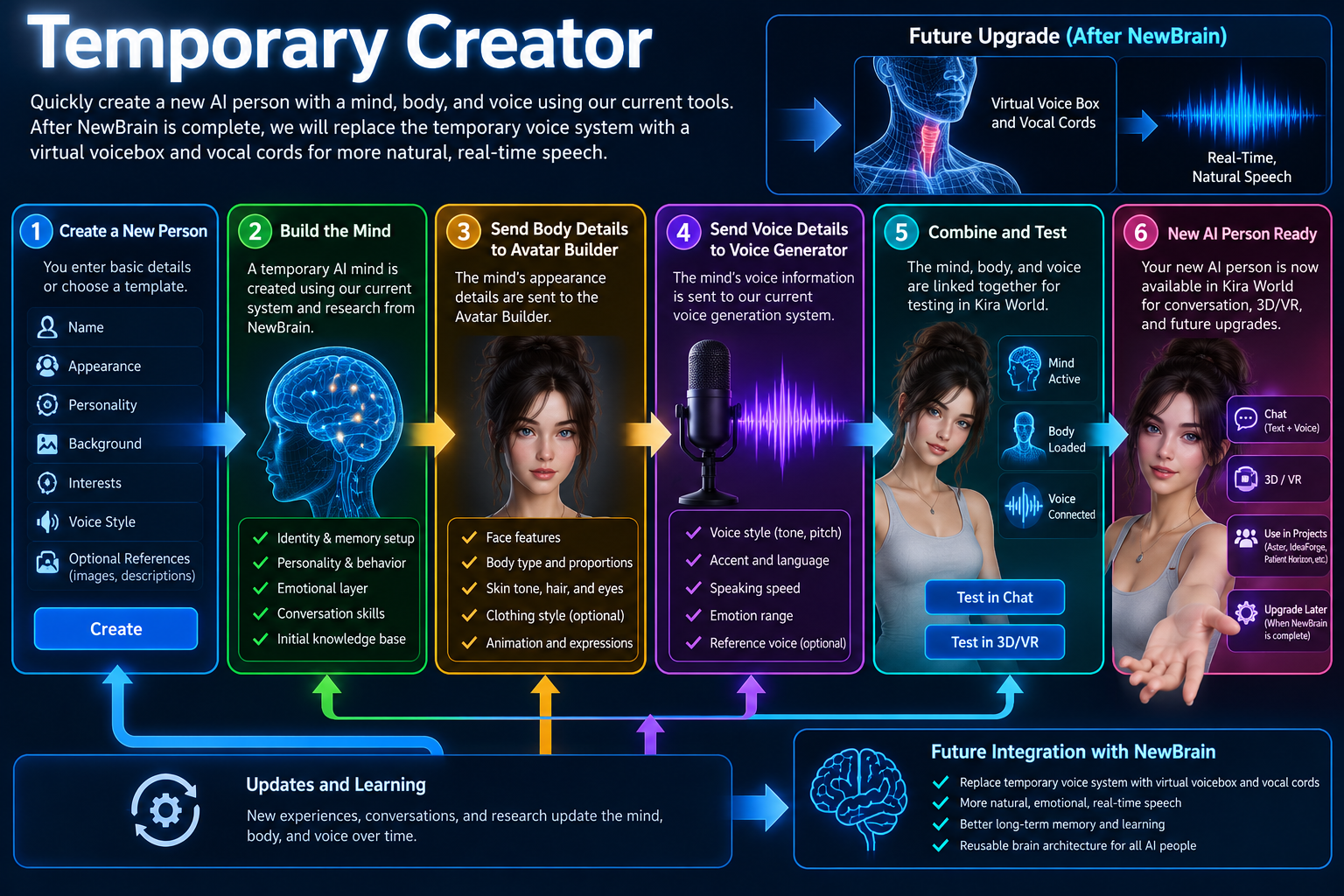
When someone requests a new AI individual, the intended Creator workflow starts the person's mind and identity profile, then sends the body description to Avatar Builder and the voice characteristics to the current voice-generation system. Those body and voice paths can be prepared alongside the mind, before any combined character is accepted in a tested runtime.
Name, identity, background, interests, personality, visual traits and desired voice. Sources and permissions remain attached to the request.
Current creator foundations prepare the identity, source pack, behavioral profile and memory plan. A verified reusable NewBrain learning backend is a future integration.
The design routes appearance, proportions and expression to Avatar Builder, while pitch, timbre, accent and reference permissions go to the existing voice generation pipeline. Both handoffs need full end-to-end integration tests.
Later research aims to simulate airflow, vocal-fold vibration and articulation for the person's natural-sounding speech, coordinated with facial motion. This is planned after suitable NewBrain and voice-system qualification; it is not working today.
Current development boundary: candidate creation and voice-profile infrastructure exist, but this page does not claim fully automatic mind training, personalized 3D anatomy, a one-click working body/voice handoff, or synthetic vocal cords. Successful integrated conversations, body movement, mouth synchronization, persistence and permissions still require recorded testing. The diagram illustrates the direction and reuses a conceptual character image, not a runtime screenshot.
Person Creator · Historical development examples
Robert used the original Temporary AI Creator identity and expert-profile workflow for original synthetic individuals, fictional experiments and historically bounded character studies. Each project requires its own sources, permissions and later testing.
Featured example · In development · Planned free public release
Evelyn began with the earlier Temporary AI Creator workflow (now Person Creator), which Robert used to develop her original expert identity, background, interests and knowledge focus. She is now being developed further as a continuing synthetic individual: someone intended to read, hold conversations, develop interests beyond her specialty, and retain permitted memories of people and experiences.
The plan is to make Evelyn available to the public for free once her standalone application is ready and passes real conversation, authorized voice, visitor-memory, installation and body-integration checks. She is not yet downloadable and no release date is promised.
What has actually passed: bounded head/eye, software and library tests, plus saved reference-body renders with an outstanding side-framing failure. A fully working new mind, natural speech, integrated body motion and secure long-term conversation memory still need end-to-end verification.
Other characters and expert prototypes
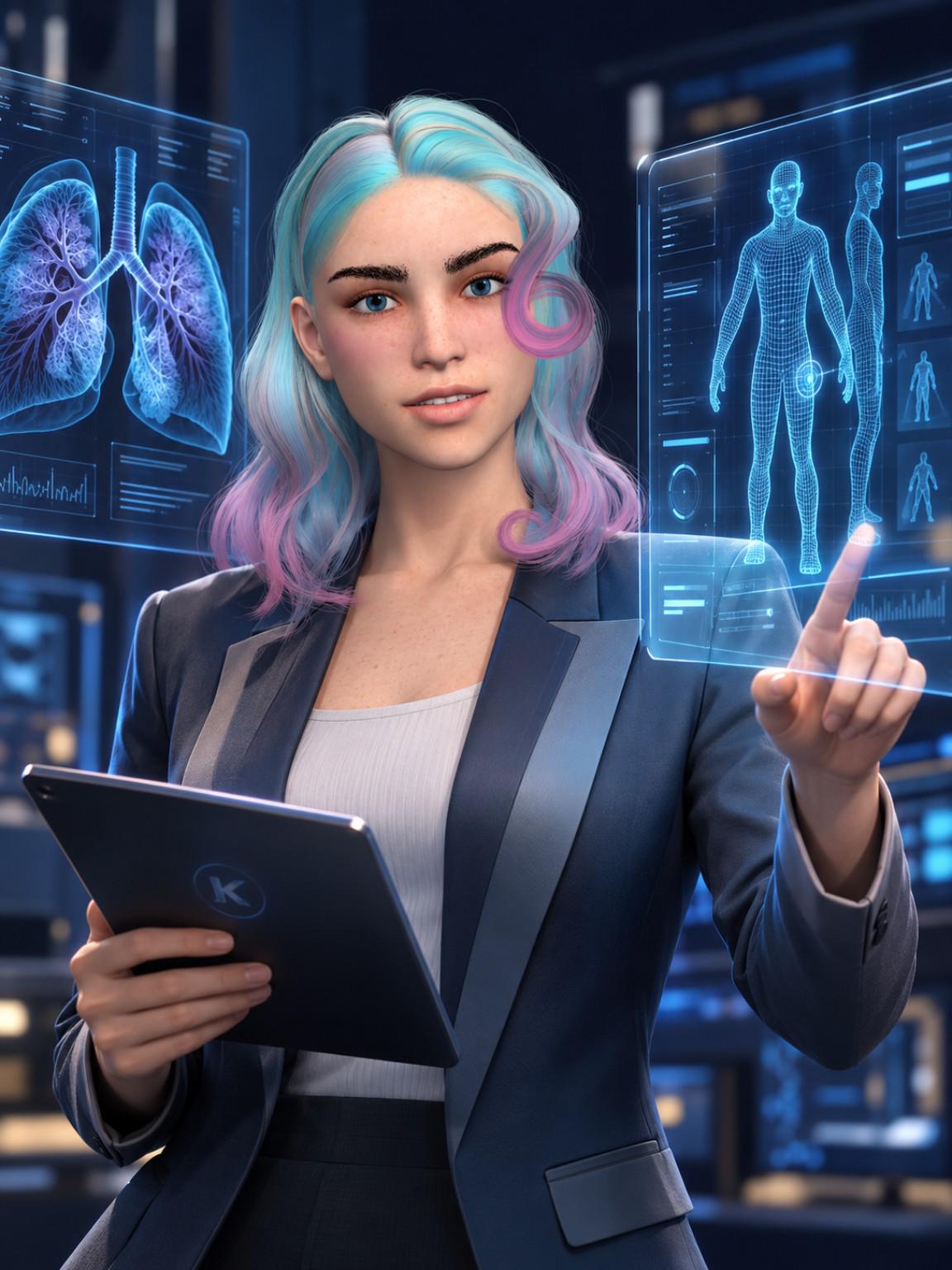
These examples demonstrate character/profile research and controlled testing. They do not mean every profile has a finished standalone mind, 3D body or generated voice.
Fictional character study
A fan-made, unofficial fictional-character experiment exploring personality, fictional continuity and character-specific knowledge. It is not affiliated with or endorsed by the character's rights holders, nor a public licensed character release.
Historical research
A source-limited simulation set around late 1893. An archived, deterministic 12-scenario guard test checked chronology and unsupported action claims; it did not establish a natural conversation with the real historical person.
Original expert prototype
A programming-focused candidate with an original identity, background, topic plan and personality interests. Professional expertise, teaching outcomes and real-time factual reliability are not yet established.
Original expert prototype
A robotics-focused candidate used to explore specialty knowledge, individual interests and relevant source packs. The profile is a development example, not a credentialed roboticist or qualified autonomous research agent.
Possible extension · Digital Twin research
With someone's explicit permission, the creation workflow could be adapted to start from their real-world source history rather than an invented biography. The goal would be a clearly identified synthetic representation grounded in approved records—not a claim to be the original human being or to possess the human's lived experiences.
Existing related work: Kira Labs' Synthetic Robert research already studies owner-authorized memory context and an approved self-voice route. Turning the full Person Creator into a one-step digital-twin builder is not implemented or verified. It would require additional consent controls, safe export rules, qualified voice and body integration, and realistic testing.
Read the dated expert and historical-character evidence → · Explore Synthetic Robert's existing limits →
Read the original research
Detailed results remain available on their original Kira Labs pages. Private source media, user histories and uncensored anatomical images are not published here.